
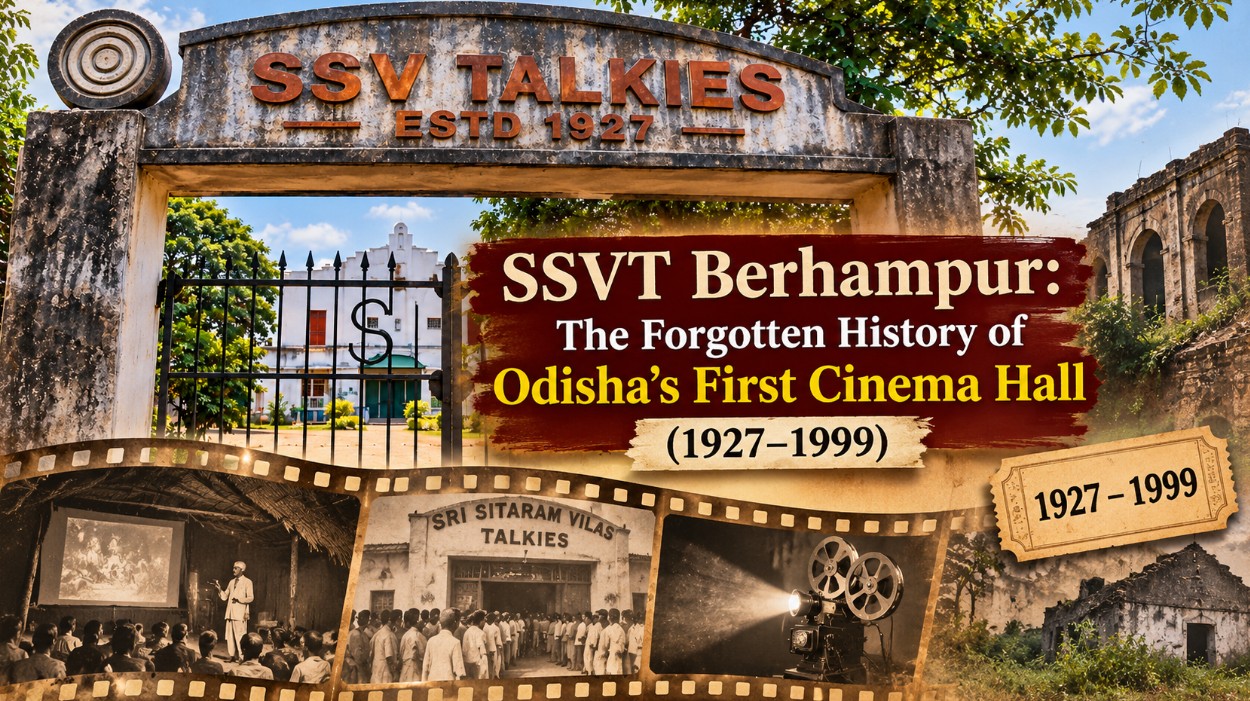
Long before multiplexes, digital projectors and streaming platforms transformed the way we watched films, there stood a humble cinema hall in Berhampur that introduced generations of people to the magic of moving pictures. Sri Sitaram Vilas Talkies, fondly remembered as SSVT, was more than just a movie theatre. It was a landmark in Odisha's cinematic history and an inseparable part of Berhampur's cultural identity.
When Cinema Was Still a Novelty
Imagine Berhampur nearly a century ago. A relatively quiet town in the erstwhile Ganjam district, where entertainment options were limited and the idea of watching moving images on a giant screen was still an extraordinary experience.
There were no television sets in people's homes, no smartphones and certainly no online entertainment. For many, the cinema hall was their first window into a world beyond their everyday surroundings.
It was in this setting that Sri Sitaram Vilas Talkies, popularly known as SSVT, came into existence in 1927. Established by Sri Atmakuru Buchichetty, the theatre occupies a special place in the history of cinema in Odisha. It was among the earliest cinema halls in the region and is widely remembered as the state's first cinema theatre.
Interestingly, SSVT began its journey during the silent-film era, long before talking pictures became the norm in Indian cinema. At a time when cinema itself was still finding its place in Indian society, this little theatre in Berhampur was already bringing the magic of the silver screen to local audiences.
The Days of Silent Films and Storytelling
The early days of SSVT were quite different from what we associate with cinema today.
The theatre initially had a thatched roof, and there were no conventional seats. Spectators sat on the sandy floor, watching the flickering images projected onto a screen. Yet, the absence of comfortable seating or modern facilities did little to diminish the excitement of the experience.
Since silent films had no recorded dialogue, audiences needed someone to explain what was happening on the screen. According to accounts of the theatre's early years, a man named Shivarao would sit on a chair in front of the screen, holding a microphone and narrating the story as the film unfolded.
His explanations helped audiences follow the characters, understand the plot and become emotionally involved in the story. In many ways, he was the bridge between the silent images and the imagination of the audience.
One can only imagine the atmosphere inside that modest theatre: the whirring projector, the moving shadows on the screen, the narrator's voice and an audience captivated by a form of entertainment that was still relatively unfamiliar.
As the popularity of cinema increased, SSVT gradually evolved. The original thatched structure was replaced by a concrete building, and seating arrangements were introduced. A section of seats towards the rear was reserved for the more privileged spectators, reflecting the social distinctions of the time.
A Theatre That Witnessed the Evolution of Indian Cinema
SSVT's history is closely associated with the formative years of Indian filmmaking.
The theatre is remembered for screening landmark productions from the silent and early talkie eras, including Dadasaheb Phalke's Raja Harishchandra (1913), widely recognised as India's first full-length feature film, and Alam Ara (1931), India's first talkie.
These were not merely films. They represented two defining milestones in the evolution of Indian cinema, and their association with SSVT adds to the theatre's historical significance.
The cinema hall also attracted visitors beyond the local population. British visitors who came to spend their holidays along the beaches of Gopalpur reportedly visited SSVT to watch Indian as well as English films. The theatre even had the distinction of being visited by V.V. Giri, who later became the President of India.
In an era when film production was limited and cinema halls were relatively few, SSVT also served as a venue for stage performances. Telugu dramas were frequently staged there, making the theatre a space for both cinema and live entertainment.
It was, in essence, one of the important cultural gathering places of its time.
When the First Odia Film Reached Berhampur
The arrival of sound transformed Indian cinema during the 1930s. Talking pictures brought dialogue, songs and music to the silver screen, creating an entirely new cinematic experience.
SSVT adapted to these changes and continued to entertain audiences as filmmaking evolved.
One particularly significant chapter in its history was its association with Sita Bibaha, the first Odia feature film, directed by Mohan Sundar Deb Goswami. Released in 1936, the film marked the beginning of Odia feature filmmaking. Accounts of SSVT's history also associate the theatre with its early screening in Berhampur.
During its earlier decades, the theatre screened a variety of Hindi and English films, alongside Odia and Telugu productions. As more cinema halls opened in Berhampur, however, its programming gradually became more specialised. SSVT increasingly became known for screening Telugu films and Hindi productions associated with South Indian filmmakers.
The theatre was adapting to a changing entertainment landscape while retaining its own distinctive identity.
The Experience of Watching a Film at SSVT
Perhaps what made SSVT truly special was not simply the films it screened, but the entire experience of visiting the theatre.
Over the years, its infrastructure underwent several changes. The original projection arrangements gave way to more advanced equipment, including a 35 mm projection machine reportedly brought from London.
In its early days, the hall could accommodate approximately 1,000 spectators. Later, as seating arrangements were improved to provide greater comfort, its capacity was reduced to around 600.
There were little rituals that made every visit memorable.
A light positioned above the theatre and the ringing of a bell announced the beginning of a show. For those waiting outside, that signal meant it was time to enter and find their seats.
And then came the interval.
Local vendors would hurry towards the audience, selling snacks and refreshments. A nearby canteen was another attraction, remembered for its food and the lively atmosphere surrounding the theatre.
For many families, a visit to SSVT was more than simply watching a movie. It was an outing, an occasion and an opportunity to spend time together.
People travelled from surrounding areas to Berhampur to experience the films screened there. At a time when entertainment choices were limited, SSVT was one of the town's major attractions.
It was a place where strangers shared laughter, families created memories and generations discovered the magic of cinema.
1999: The Super Cyclone That Changed Everything
Every great story has its turning point. For SSVT, that moment arrived in October 1999.
Odisha was struck by a devastating super cyclone that caused widespread destruction across the state. Buildings were damaged, trees were uprooted, communication networks collapsed and countless lives were affected.
Berhampur and the surrounding areas were not spared.
The historic SSVT building suffered severe damage during the cyclone, with a substantial portion of the structure collapsing. The theatre, which had survived decades of changing cinematic trends, had finally encountered a disaster from which it would never recover.
Its operations came to an end.
For a building that had entertained audiences for nearly 73 years, the closure marked the end of an extraordinary chapter.
There were no more crowds gathering at its entrance, no ringing bells announcing the next show and no excited conversations during intervals. The projector fell silent, and the screen that had once transported audiences into countless imaginary worlds was left without an audience.
Why the theatre was never fully restored remains an unanswered question in its history. Whether due to financial constraints, the extent of the structural damage or other circumstances, the restoration that might have brought SSVT back to life never materialised.
From a Cultural Landmark to a Forgotten Space
The passage of time has further changed the landscape that once surrounded SSVT.
The area that once witnessed crowds of moviegoers became quiet and largely deserted. The theatre's remains gradually turned into a reminder of a bygone era. On occasions, the open space has reportedly been used for exhibitions and festival-related activities.
Yet, for many older residents of Berhampur, SSVT has never really disappeared.
Its memories survive in conversations about old films, childhood outings, family visits and the excitement of watching a movie in a packed theatre.
The story of SSVT is also part of a much larger transformation in Odisha's cinema culture. Across Berhampur and other towns, several single-screen theatres have either shut down, been demolished or found alternative uses. Changing audience preferences, the growth of multiplexes, the arrival of television and OTT platforms, rising operational costs and the increasing commercial value of urban land have all contributed to the decline of traditional cinema halls.
But SSVT's story is particularly poignant because its disappearance was not simply the result of changing times. A natural disaster brought an abrupt end to a theatre that had already witnessed almost three-quarters of a century of cinematic history.
The Screen May Have Gone Dark, But the Story Must Live On
The story of SSVT is not merely the story of a cinema hall that closed its doors after a devastating cyclone. It is the story of an era when cinema brought an entire town together, when watching a film was an occasion to celebrate, and when a modest theatre could become the cultural heartbeat of a city.
From its humble beginnings in 1927 to its final days in 1999, Sri Sitaram Vilas Talkies witnessed the evolution of Indian cinema and introduced generations of people in Berhampur to the magic of the silver screen. Its legacy is now reflected in the memories of those who once stood in its ticket queues, listened to the ringing bell announcing a show, enjoyed snacks during intervals and shared unforgettable moments inside its auditorium.
But SSVT's story also raises a larger concern. As historic cinema halls disappear across Berhampur and other parts of Odisha, are we slowly losing an important part of our cultural heritage? Buildings may be demolished, names may fade from city maps and familiar screens may go dark, but the history associated with these places deserves to be preserved.
Perhaps SSVT may never reopen its doors to moviegoers. Yet, its historical significance should not be allowed to disappear with its crumbling walls. Documenting its past, preserving its memories and recognising its contribution to Odisha's cinema history could ensure that future generations know where this remarkable journey began.
After all, SSVT was not just a place where films were screened. It was where memories were created, generations found entertainment and Berhampur discovered its love for cinema. The final show may have ended, but the legacy of SSVT deserves an everlasting place in Odisha's history.